Ethics Class 08
BRIEF DISCUSSION ON THE DOUBT OF THE STUDENTS (5:04 P.M.)
PERSUASION (5:06 P.M.)
- Topic Plan
- (a) Concept and Examples.
- (b) Elements of Persuasion.
- Steps involved in Persuasion.
- Aristotle's Perspective on Persuasion.
- (c) Characteristic features of elements of Persuasion.
- Source
- Message
- Receiver
- (d) Cognitive Dissonance
CONCEPTS AND EXAMPLES
- Persuasion is a type of social influence in which a person or group's attitude or behaviour toward an object, idea, person, etc is changed through direct interaction via spoken or written words.
- For example,
- (a) Speeches at political rallies to persuade people to vote for their political party.
- (b) Street play concerning the social issues in society such as domestic abuse, child marriage, child labour, etc.
- (c) Mukti caravan initiative under Bachpan Bachao Aandolan.
- (d) Through cinema such as Taare Zameen Par, Thappad, Pink, Padman, Toilet- Ek Prem Katha, etc.
- (e) Pictoral warning on the cigarette packings.
- Persuasion is considered a positive concept since it is an act that will enable people to do things that have positive outcomes.
- However, manipulation is considered immoral because it is convincing someone by unfair means for one's advantage.
- Examples of manipulation are, Gaslighting or Propaganda.
ELEMENTS OF PERSUASION
- 'Who said, what to whom, by what means.'
- The four elements are Receiver, Sources, Message, and Channel.
- Steps involved in Persuasion
- (a) Attention
- For the source to catch the attention of the target group, the message presented should be interesting, unique, and utilitarian, and should be able to generate curiosity in the minds of the receiver.
- (b) Comprehension
- It refers to the ability of the source to make the target group understand the message.
- It is possible only when the message is designed taking into consideration the target group's frame of reference.
- (c) Retention
- The target group should be able to retrieve the message presented and this is possible only when the message is presented repeatedly and salient features are highlighted.
- (d) Acceptance and Action
- Persuasion is said to be successful if the target group not only receives the message but also acts upon it.
- For example, the Bultoo experiment by Alex Paul Menon.
- Aristotle's Perspective on Persuasion (5:43 P.M.)
- He is known as the father of persuasion.
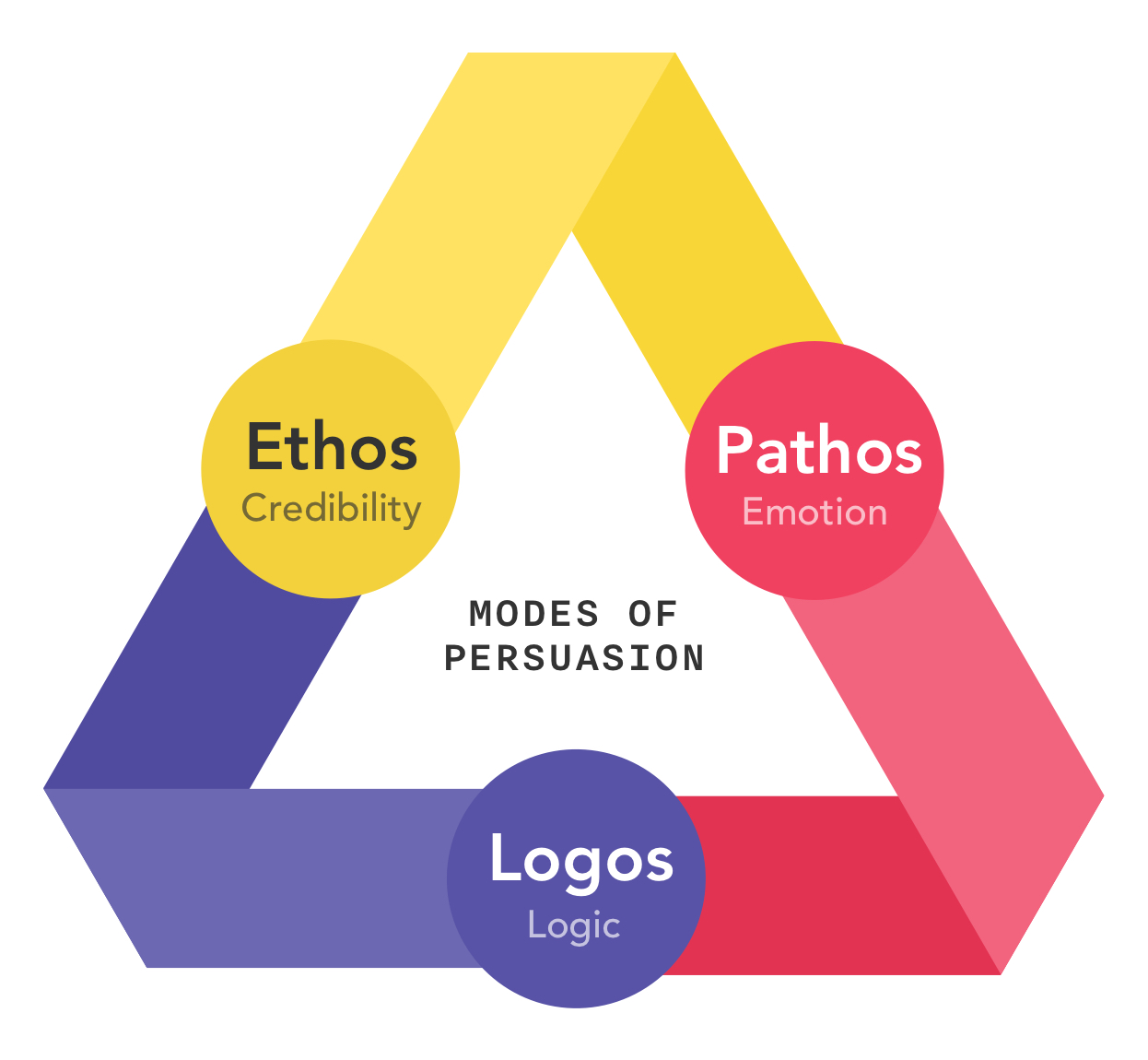
- According to him, there are three ways to bring about a successful persuasion: Ethos, Pathos, and Logos.
- Ethos
- Ethos involves appealing to ethics by establishing the credibility of the speaker.
- Convincing the target group regarding the credibility of the speaker.
- It is ensured through the following:
- (a) Known figure in the field under consideration.
- (b) Demonstrating mastery over the specialized vocabulary of the field.
- (c) The speaker is introduced by another established authority.
- Pathos
- Pathos involves appealing to the emotions.
- It is an effective means of persuasion when both the speaker and the target group have the same underlying values.
- It is used by invoking sympathy among the target group towards the speaker.
- It is ensured by:
- (a) Using emotional tone.
- (b) Giving emotion-evoking examples.
- (c) Making funny illustrations, etc.
- For example, to improve the status of the girl child initiatives such as selfies with daughter.
- Logos
- Logos involves appealing to logic.
- It means quoting statistics, data, facts, etc.
- Logos further enhances the ethos as it means the speaker looks knowledgeable.
- It can be ensured by the following:
- (a) Through historical analogies.
- According to Mark Twain, history never repeats itself, but it does often rhyme. For example, Spanish flu and Covid-19.
- (b) Constructing logical arguments.
- (c) Substantiating arguments with examples.
CHARACTERISTIC FEATURES OF ELEMENTS OF PERSUASION (6:08 P.M.)
- Source
- Credibility
- Credibility is defined as the extent to which the target group believes in the position advocated by the source.
- It depends upon:
- Trustworthiness (walking the talk or consistency in the past behaviour)
- Expertise (Knowing the subject).
- Credibility leads to conformity.
- Attractiveness
- The source is liked by the target group, hence, the acceptance of the counter-message is possible.
- It depends on the three factors, Physical attractiveness, communication skills, and ideological similarity.
- It leads to identification with the source.
- Power
- It is the ability of the individual to exercise their will in community action despite the resistance by others.
- It leads to compliance.
- Scenarios
- (a) For The persuasion to be successful, the message should come from a highly credible source.
- However, the degree of acceptance of the persuasive message of the highly credible source declines over the period, and that of the low credible source increases. This is the sleeper effect.
- (* Refer to the graph drawn by the faculty.)
- Hence, the highly credible source needs to reinforce their credibility time and again to ensure successful persuasion.
- (b) The businessman owning the polluting industry shuts down the industry. Although previously he was a low credible source, now people would cater to his message more.
- This example signifies that sometimes the low-credible source is successful in persuasion against a highly credible source provided they are advocating against their fundamental interest.
- Message
- (a) Message Discrepancy
- (*Refer to the diagrams drawn by the faculty. ) (6:51 P.M.)
- ZoA- Zone of Acceptance.
- ZoI- Zone of Indifference.
- ZoR- Zone of Rejection.
- Facilitators- These people are open-minded, educated, rational, tolerant, flexible, patient, etc.
- Resistors- They are orthodox, rigid, conservation, pessimist, and stubborn.
- Fence sitters- They are indecisive. They lack courage and lacks decision-making ability.
- In general perception, one should always look for facilitators who have a wider zone of acceptance.
- It is perceived that the discrepancy in the position advocated by the source and the one held by the target group is underestimated and hence the message will be accepted.
- We can further widen the zone of acceptance by:
- (i) Choosing a source that is credible, attractive, and powerful.
- (ii) Making the message interesting and utilitarian.
- (iii) Presenting the message in a culturally congruent manner.
- For example, political speeches in the local language.
- (b) Fear Appeal (7:08 P.M.)
- It is the most common method of persuasion.
- For example, advertisements related to food supplements such as Horlicks, Bournvita, etc.
- Here the fear of peer pressure is created to ensure the consumption of these products.
- Similarly, persuading the younger sibling to study hard by creating the fear of failure.
- It is believed that mild fear appeal works better as compared to strong fear appeal because strong fear appeal produces a defence mechanism where the target group insulates themselves from the message issued by the source.
- For example, the role of media during COVID-19, pictorial warnings on cigarette packets, fear of social boycott in the context of intercaste marriage or homosexuality, the application of karma theory, mock drills for the natural disaster, cyber-attacks on employee's computers, etc.
- (c) Drawing Conclusions
- (d) Sideness of Message
- (e) Pleasant form of Distraction
- (f) Channel factor
- Receiver
- (a) Selective Exposure
- (b) Selective Attention and Comprehension
- (c) Intelligence
THE TOPIC FOR THE NEXT CLASS: PERSUASION (CONTINUED)